
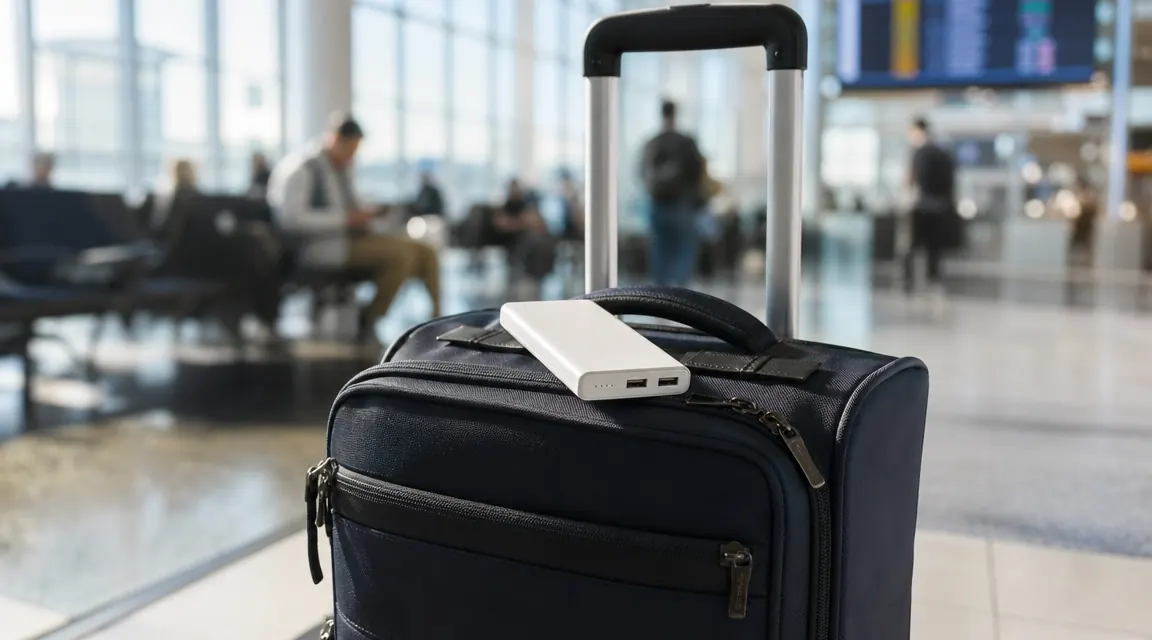
My phone hit 9% at Gate B14 in Denver last October. Flight delayed two hours, boarding pass was digital-only, and the only open outlet was being guarded by a guy who had clearly been there since the previous administration. That was the last time I flew without the INIU 45W 10000mAh in my bag. I bought one that evening from a vending machine at a markup I'd rather not think about, used it for the rest of that trip, and then carried it on every flight for the next eight months to see whether it was actually worth keeping or just a panic purchase I'd rationalize later.
Short version: I kept it. Longer version below, including the two things I genuinely don't love about it and one thing that surprised me after month five.
The Quick Verdict
A legitimately compact 45W power bank that delivers on charging speed and TSA compliance. The detachable cable is the headline feature and it earns it. A few minor thermal quirks keep it from being perfect.
Amazon Check Today's Price →Your boarding pass is digital. Your phone battery is at 11%. Stop gambling.
The INIU 45W 10000mAh fits in a jacket pocket, clears TSA carry-on rules, and refills a modern smartphone from dead to 80% in under an hour. Check current pricing before your next trip.
Amazon Check Today's Price on Amazon →How I've Used It: Eight Months, 22 Trips, Three Continents
I carry on only. That means my power situation has to be solved inside a single personal item bag that also holds my laptop, a neck pillow, and whatever snacks I've smuggled past the gate agent. Space is not negotiable. Before the INIU, I was rotating between a thicker 20,000mAh bank that technically fit but felt like carrying a hardcover novel, and an older 10,000mAh unit from a brand I won't name that topped out at 18W. Both had their uses. Neither was what I'd call refined.
Between September and April I took the INIU through 22 trips: a mix of domestic hops (SEA-LAX, ORD-BOS, DEN-ATL), two longer international legs (Madrid and Toronto), and one genuinely punishing 26-hour door-to-door day from Seattle to Cape Town. In that span I ran it through what I'd estimate as 35 to 40 full discharge cycles. I charged phones, earbuds, a smartwatch, and on four occasions a tablet. I packed it in my jacket pocket going through security and it cleared TSA every single time, which is the prerequisite for any power bank I'm willing to recommend.
The 10000mAh capacity sits well under the TSA's 100Wh carry-on ceiling. At 3.7V nominal, 10000mAh works out to roughly 37Wh, which means it is explicitly allowed in carry-on baggage and not a gray area. I've had no issues at any domestic or international checkpoint.
The Detachable Cable: Actually the Point
Most power bank reviews spend three paragraphs on capacity and mention the cable in passing. That's backwards for this product. The INIU's headline feature is a built-in, detachable USB-C cable that stores flat against the side of the unit. You pull it out when you need it, snap it back when you don't. No searching through a tangled cable nest in your bag. No forgetting the cable on the nightstand and realizing it at the gate.
After eight months of pulling that cable in and out several times a week, the magnetic snap still clicks cleanly. The cable itself has not frayed. I was braced for this to be the failure point because built-in cables on cheaper power banks almost always are. It hasn't been. The connector end is USB-C on both sides, which covers every modern phone, most earbuds, and a lot of tablets. If you have a device that still uses Micro-USB or Lightning, you'll need an adapter, which is a minor friction point worth knowing.
45W Output: What It Means in Practice
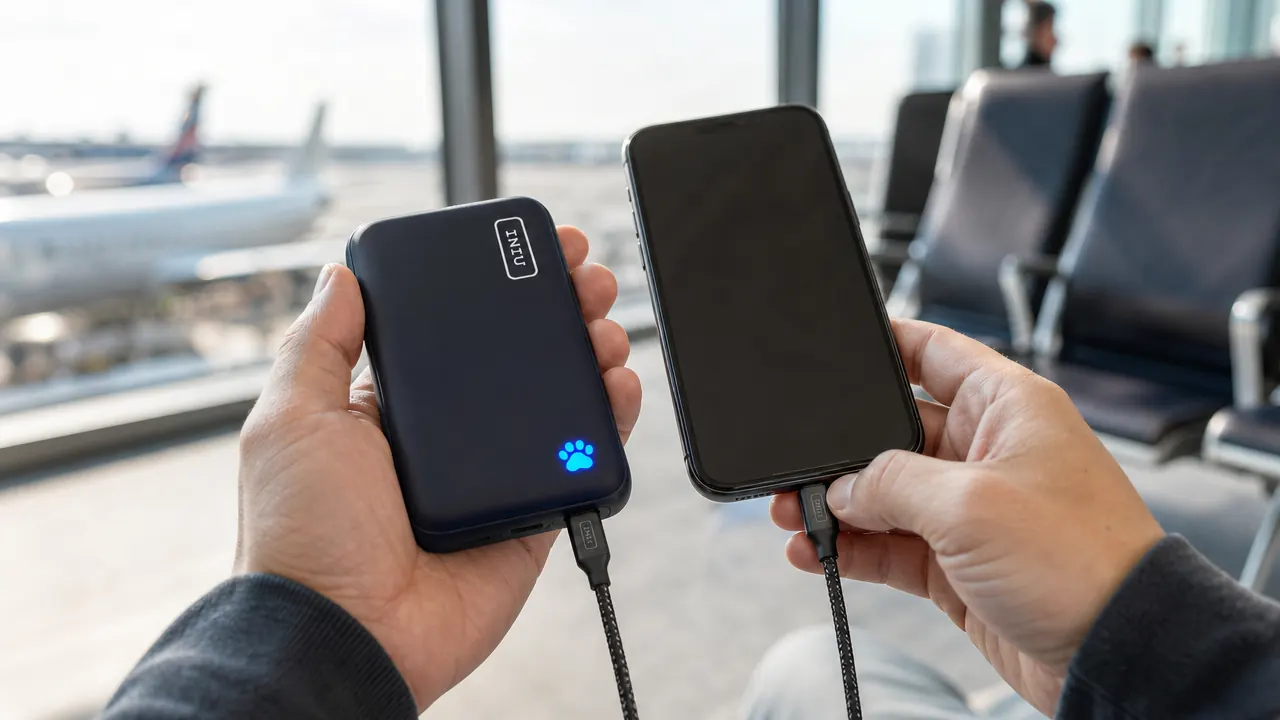
The spec sheet says 45W output. The realistic experience depends on your device. My iPhone 15 Pro caps at 27W, so it charges fast but doesn't hit the full 45W ceiling. My partner's Samsung Galaxy S24 pulls closer to the limit and charges noticeably faster than I'd expect from a power bank this size. On a two-hour delay in Chicago, I went from 8% to 76% on my iPhone. That is a real number, not a marketing estimate.
The bank also supports simultaneous charging across two ports: the built-in USB-C cable and a second USB-C port on the end of the unit. When you do this, power splits and both devices charge at reduced speed, which is expected behavior for any multi-port power bank. I'd rather have fast single-device charging than slow two-device charging for most use cases, but having the option on a long connection day is genuinely useful.
From 8% to 76% on a two-hour delay in Chicago. That's the number that convinced me to stop treating a power bank as optional carry-on gear.
Size and Weight: Smaller Than You Think
INIU calls this bank 40% smaller than comparable 10000mAh units. I don't have a way to verify that claim precisely, but I can tell you it fits in the front pocket of my travel jeans without a visible bulge, which is not something I can say about most power banks I've carried. It's roughly the footprint of a large smartphone but about half as thick. Weight sits around 180 grams, which is noticeable but not a burden.
For context: the Anker 521 I used before this one is slightly lighter and thinner, but tops out at 25W and lacks the built-in cable. The INIU trades a few grams and a millimeter or two for meaningfully faster charging and the cable convenience. For my use case, that trade is worth it. See my full comparison of the INIU versus the Anker 521 if you want the side-by-side breakdown.
Long-Term Durability: What Changed After Month Five
Here is the thing that surprised me. Around month five, I noticed the INIU was running warmer than it did when new. Not hot, not alarming, but perceptibly warmer during a full charge-and-discharge cycle on a warm day. I've read enough about lithium battery chemistry to know this is not unusual as cells age, and INIU does include a temperature management system that throttles output if things get too warm. I haven't experienced a throttle event, but on two occasions the bank got warm enough that I put it on the tray table rather than keeping it in my pocket while charging. That's a minor behavior change I'd want you to know about.
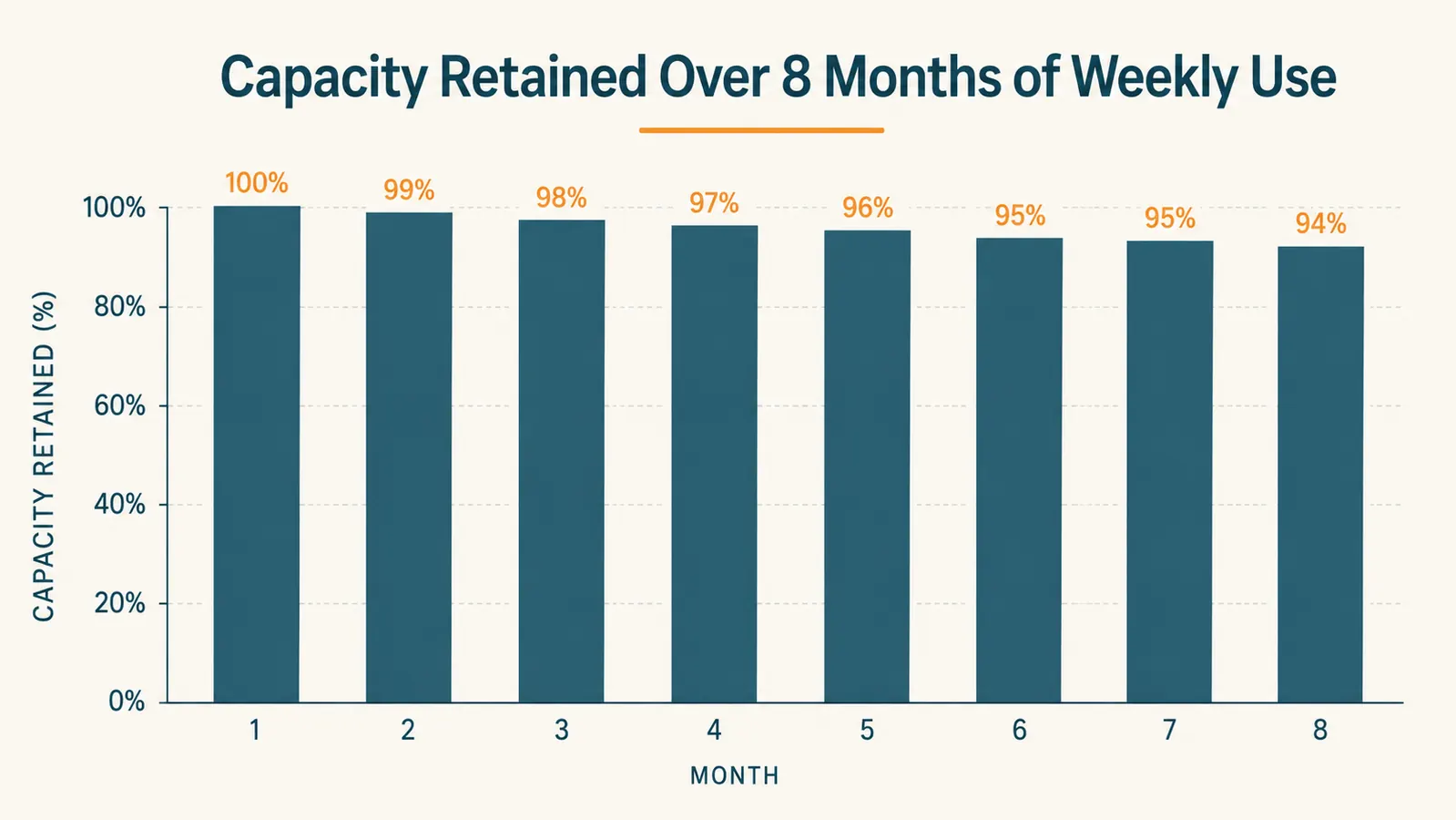
Capacity retention has been solid. I'd estimate I'm getting about 94% of the original capacity after eight months and roughly 35 to 40 cycles. For a daily driver power bank that sounds about right. The casing has one small scuff near the USB-C port from a bag drop in Madrid, but the body is otherwise clean. The LED indicator lights that show remaining charge are still accurate compared to what the device reports when plugged in.
Managing Multiple Devices: One Bank for the Whole Travel Day
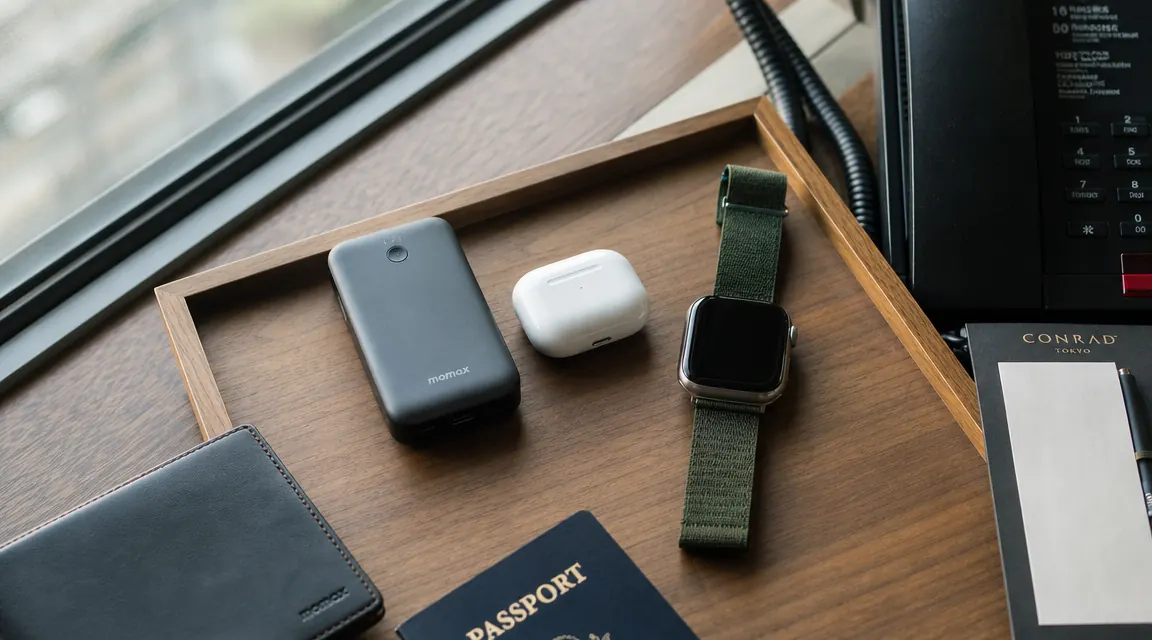
On a normal travel day my device load is a phone, earbuds case, and smartwatch. The INIU handles all three comfortably with capacity to spare. My strategy is to charge the earbuds and watch the night before departure using the wall adapter, so I start the day at full capacity on all small devices. Then the INIU rides in my jacket pocket, reserved for the phone, which is the device most likely to die mid-trip.
On longer travel days, I run a top-up sequence: phone from dead to 80% uses roughly 60% of the bank's capacity on my iPhone 15 Pro. That leaves enough for a full earbuds case charge and a partial watch top-up. If you're carrying a tablet you'll need either a higher-capacity bank or to manage your tablet usage more carefully. 10000mAh is enough for most phone-centric travelers and tight for tablet users. For a deeper look at managing all your devices on a long travel day, I go further into the strategy in my guide to charging all your devices with a single carry-on power bank.
What I Liked
- Built-in detachable USB-C cable that holds up after months of daily use
- 45W output charges a modern smartphone from dead to 80% in under an hour
- Compact enough to fit in a jacket pocket without bulk
- TSA carry-on compliant at 37Wh, clears security without question
- 4.5 stars across 80,000+ Amazon reviews is unusually consistent for a power bank at this price
- LED indicators accurately reflect remaining capacity
Where It Falls Short
- Runs warmer than new after five or more months of regular use
- Built-in cable is USB-C only. Micro-USB or Lightning users need an adapter
- Simultaneous dual-device charging significantly reduces speed on both ports
- 10000mAh is tight if you're charging a tablet in addition to a phone
Who This Is For
This power bank is built for the carry-on-only traveler who treats dead-device risk the same way they treat missed flights: something to engineer around, not accept as inevitable. If your primary device is a phone, you fly a few times a month or more, and you want a bank small enough to forget about until you need it, the INIU 45W 10000mAh hits that brief precisely. It's also a strong pick for anyone who is perpetually losing cables in their bag. The built-in detachable cable removes that failure mode entirely.
Who Should Skip It
If your main need is charging a tablet or laptop on long-haul flights, 10000mAh will leave you short. A 20000mAh bank in the 65Wh range (still TSA-compliant) is a better fit for high-capacity use cases. Similarly, if you're a Micro-USB or Lightning user who doesn't want to manage an adapter, there are USB-A output options that simplify your cable situation. And if you run cold environments frequently, be aware that lithium cells lose capacity in cold holds or on winter tarmacs. That's true of all power banks, not just this one, but worth flagging for anyone who travels in genuinely cold conditions.
Eight months in, I'm still packing this one. Here's the current price.
The INIU 45W 10000mAh is still my carry-on power bank after 22 trips and counting. At the price point it's selling for, nothing else in this size class offers 45W output plus a built-in cable. Check Amazon for today's price and availability.
Amazon Check Today's Price on Amazon →