
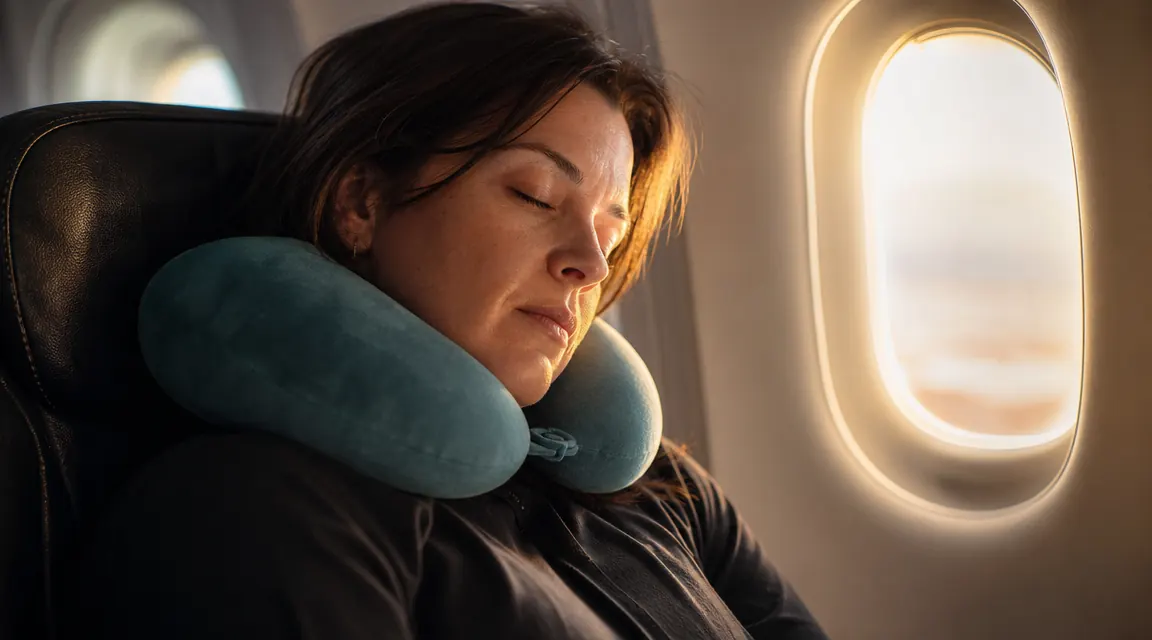
I bought the Cabeau Evolution S3 after a miserable overnight from Seattle to New York in 14D, a middle seat, no window, and the kind of inflatable pillow that slowly deflates around hour three. I landed with a stiff neck and a bad attitude. A friend who logs serious miles recommended the Cabeau and told me to stop overthinking it. I ordered it that same night and have packed it on every flight since, fourteen trips over six months, ranging from a ninety-minute puddle-jumper to Phoenix up to a nine-hour overnight to London. This review is the result of that.
The short version: the Cabeau Evolution S3 is the best neck pillow I have personally used, but it earns that label with some real tradeoffs. The seat strap system is genuinely useful, the memory foam is firm enough to actually hold position, and the washable cover is a feature I did not know I needed until I spilled coffee on myself over Atlanta. The sticking points are real too: it packs down but not small, the price is higher than most people expect for a pillow, and it runs warm on longer flights. I want to walk you through all of it.
The Quick Verdict
A carry-on-only traveler's most reliable neck pillow, with one legitimate con around bulk. Worth it for anyone flying more than four hours at a stretch.
Amazon Check Today's Price →If your last red-eye left your neck wrecked, this is the pillow that fixes that.
The Cabeau Evolution S3 is rated 4.3 stars across nearly 2,800 reviews on Amazon. Check current pricing and color options below.
Amazon Check Today's Price on Amazon →How I've Used It
I want to be specific here because general reviews drive me up the wall. I am 5-foot-8, carry a 26-liter backpack as my only bag, and almost always book economy. My typical flight involves a window or middle seat, no premium cabin upgrades, and whatever overhead space I can grab before the gate agents start pulling bags. The Cabeau rode in the outer pocket of my bag on shorter flights and clipped to the grab handle on longer ones where I knew I wanted it accessible before boarding.
Flights where I used it: Seattle to Phoenix (1.5 hours), Denver to New York JFK (3.5 hours), New York to London Heathrow (9 hours, overnight), two Chicago to LA round trips (4.5 hours each), a Reykjavik layover that turned into six hours of gate sleeping, and a handful of shorter regional hops where I mostly used it as a back cushion against the window. That is a reasonable sample size. I also washed the cover twice during the six months, once after the Atlanta coffee incident and once just because.
Before the Cabeau, I bounced between an inflatable horseshoe pillow from the airport gift shop and a J-shaped memory foam thing that was cheap and smelled faintly of the factory for about three months. Neither worked on anything over three hours. The Cabeau was a step up from day one.
What the Memory Foam Actually Does (and Does Not Do)
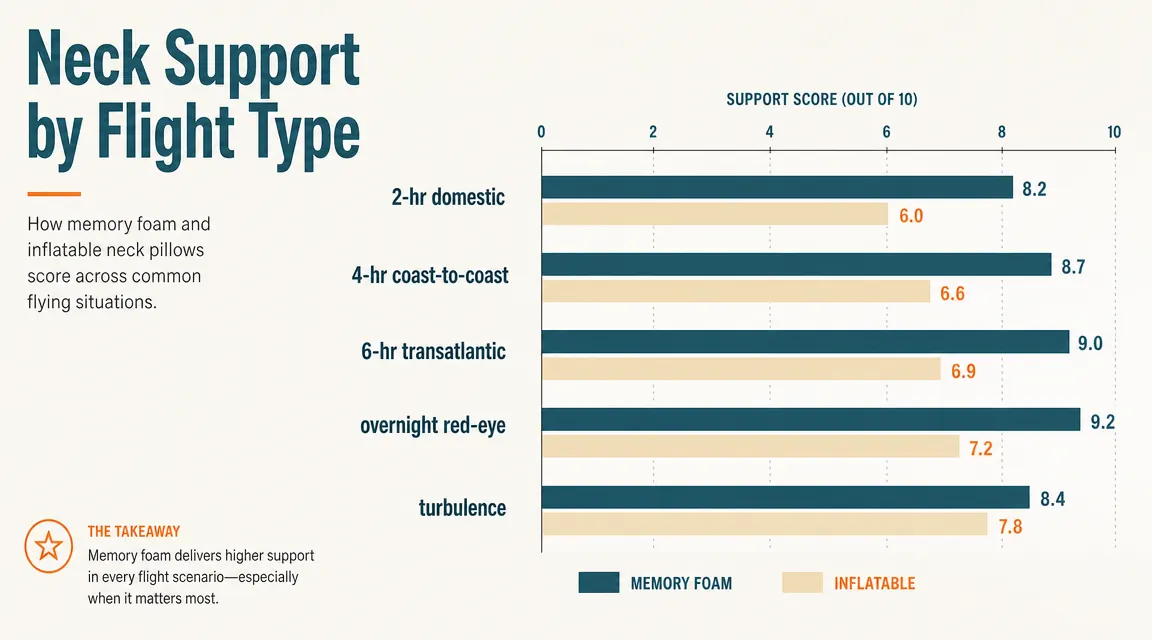
The S3 uses a thicker, denser memory foam than most travel pillows I have tried. Cabeau does not publish the foam density specs, but you can feel the difference immediately: it pushes back against your head rather than collapsing under it. On the London overnight, I slept in short 45-minute increments and woke up each time to reposition, which is normal for economy, but the pillow held its shape each time I resettled. That is the main thing memory foam does for you that inflatable cannot: it does not need to be adjusted or re-pumped after every shift.
The forward chin support is where the S3 earns its reputation. The front of the pillow is raised higher than a standard horseshoe shape, so your chin has something to rest against rather than dropping to your chest when you fall asleep in an upright seat. This is the feature that actually matters. I have used pillows with a flat front and the chin-drop problem is real. On the Cabeau, it largely disappeared on the flights where I was genuinely upright, though it is less effective if you are reclined at more than about thirty degrees.
What memory foam does not do: it does not fix a fully upright seat on a no-recline Spirit or Frontier flight. I tried it on a Frontier hop and it helped, but I still woke up with tension in my left shoulder from bracing. Nothing short of a first-class seat solves that problem completely. The Cabeau gets you most of the way there; physics gets the last few percent.
The Seat Strap System: Genuinely Useful, Not a Gimmick
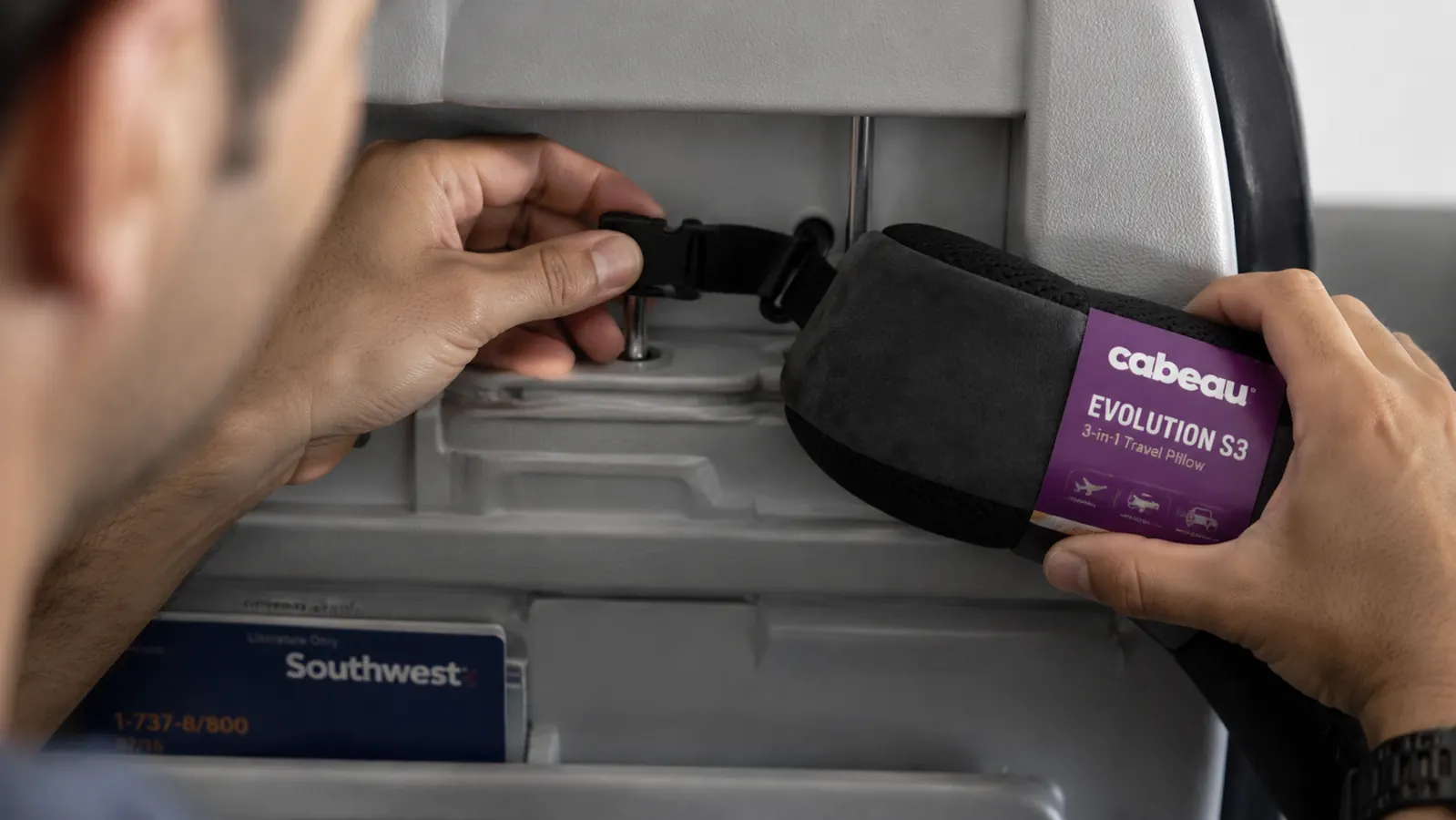
I was skeptical of the strap clips before I used them. They sounded like a marketing feature. They are not. The S3 comes with two clips that thread through the slots in most airline headrests and connect to loops on the back of the pillow. Once clipped in, the pillow stays positioned against your neck even when you shift or lean forward to check your phone. This is the difference between a pillow that slides down your back at 2 a.m. and one that is still where you left it when you wake up.
I found the clips easy to use on most planes. Delta and United headrests worked without any fuss. One older American Airlines regional jet had narrow slot spacing and I could only clip one strap, which was still better than nothing. Some ultra-low-cost carrier headrests do not have slots at all, so you are back to unclipped mode on those. Cabeau includes the straps as an add-on rather than a requirement, which is the right call.
At 2 a.m. over the Atlantic, I woke up to turbulence and the pillow was still exactly where I had left it. That alone justifies the price difference over a cheap horseshoe.
Packability: The Honest Answer
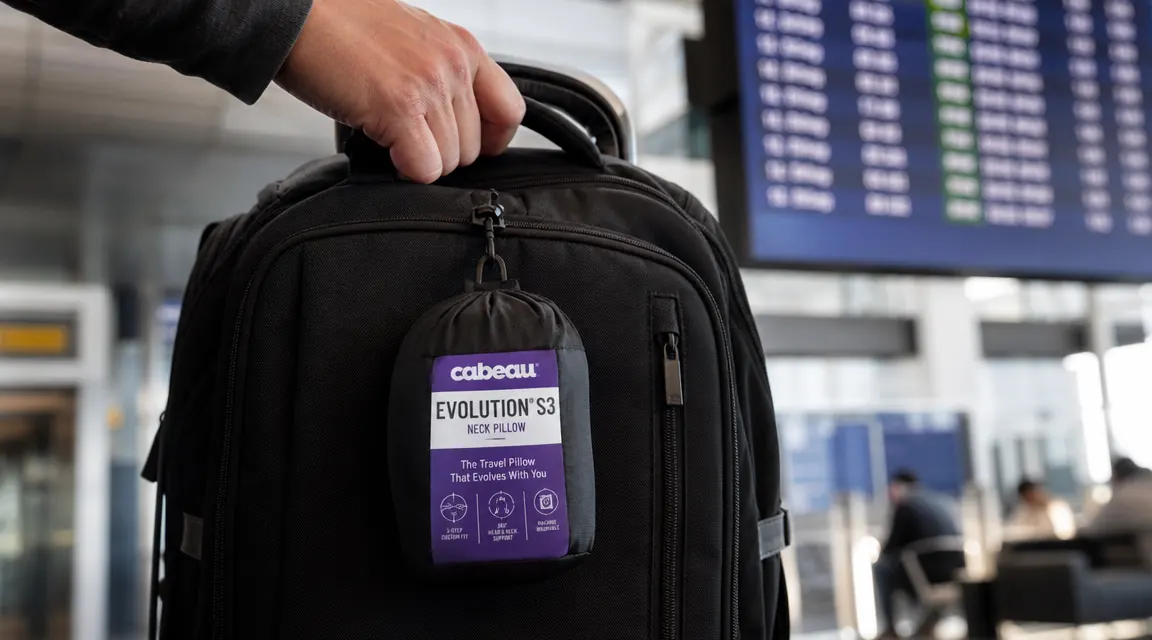
The S3 compresses into a small carry bag that reduces its size significantly, and Cabeau includes a clip so you can attach it to a bag exterior. In practice, it compresses to roughly the size of a large grapefruit. That is small enough to fit in a side water-bottle pocket on some bags, but on my 26-liter pack it always had to go in the main compartment or clip externally. On a tight packing day, it takes up meaningful space.
If packability is your primary concern, this is the honest tradeoff: the memory foam that makes the S3 comfortable is the same reason it cannot pack down to a shirt-pocket size. Inflatable pillows pack smaller. They also perform worse. For a carry-on-only traveler who counts every cubic inch, that is a real decision to make. I land on the side of performance over pack size for anything over two hours, but I have met plenty of light travelers who disagree and go inflatable for the bulk savings.
One practical note: I always clip the carry bag to my bag exterior during the boarding crush so I can grab the pillow without digging through everything. It takes about thirty seconds to unclip and slide the pillow on. That workflow makes the packability concern mostly manageable.
Heat Retention: The One Complaint I Kept Hearing and Then Experienced
The cover is soft and washable, which is a genuine win. The downside is that memory foam holds heat, and on a long flight your neck gets warm against it. I noticed this around hour four of the London overnight. The cabin had cooled down by that point, which helped, but during the warmer boarding and initial climb phase I was already feeling it. There is no airflow through solid memory foam.
Cabeau sells replacement covers and has versions with ventilated foam in some of their other models. If you run hot, that is worth knowing. For me it was a minor annoyance rather than a deal-breaker. I repositioned the pillow a few times and it was fine. But I want to name it because several Amazon reviewers mention heat as the main negative, and they are not wrong.
Alternatives I Considered Before Buying
Before landing on the Cabeau, I looked seriously at three other pillows. The Trtl Pillow, which wraps around your neck like a scarf and uses an internal plastic support, is the main competitor at a similar price. I have since tested it and written a full comparison elsewhere on this site. The short version: the Trtl packs smaller and works well if you sleep leaning hard to one side, but it does not give you the full chin support that the S3 does. For window seat sleepers who lean against the fuselage, Trtl makes a strong case. For middle seat travelers, the S3 wins.
I also looked at the Tempur-Pedic Travel Pillow, which runs significantly more, and a no-name memory foam horseshoe from Amazon that ran about twelve dollars. The Tempur-Pedic did not feel worth the premium for travel use. The cheap horseshoe lasted four months before the foam started breaking down at the seams. The Cabeau, at six months and counting, shows no meaningful wear.
What I Liked
- Memory foam holds its shape through a full overnight flight without needing adjustment
- Seat strap clips keep the pillow positioned even when you shift in your seat
- Chin support at the front prevents the head-drop problem on upright seats
- Washable cover is genuinely easy to remove, wash, and reattach
- Compression carry bag reduces bulk and clips to a bag exterior
- Build quality at six months shows no meaningful wear or foam degradation
Where It Falls Short
- Compresses to grapefruit size, not shirt-pocket size, so it does take carry-on real estate
- Memory foam holds heat, noticeable on flights over four hours in a warm cabin
- Seat strap clips require headrest slots, which not all aircraft have
- Price is higher than average compared to a standard horseshoe memory foam pillow
Who This Is For
The Cabeau Evolution S3 makes the most sense for travelers flying economy at least a few times a year on routes longer than three hours. If you regularly deal with red-eye flights, transatlantic or transcontinental routes, or long layovers in airports where you need to actually rest, this pillow justifies the price without much debate. It also makes a strong case for anyone who has already tried and given up on cheap horseshoe pillows or inflatable options, and wants to stop regretting whatever they packed.
It is also the right call for middle seat travelers specifically. A window seat gives you a wall to lean against, which reduces how much work the pillow has to do. In a middle seat, the pillow is often the only thing between you and sleeping with your head on a stranger's shoulder. The S3's chin support and strap clips matter more in that scenario.
Who Should Skip It
If you mostly fly short domestic routes under two hours and primarily want a pillow for the odd longer trip, you can probably get away with something cheaper. The S3's strengths take two or more hours to show up fully. Under that threshold, almost any pillow does the basic job well enough that the price difference is hard to justify.
If packability is your absolute priority, where every gram and cubic inch is accounted for and you are traveling ultralight, an inflatable or the Trtl is worth looking at instead. The S3 compresses impressively for a memory foam pillow, but it still requires more space than any inflatable. For a traveler already making hard cuts to fit in a 20-liter bag, that math may not work. You can read my full breakdown of memory foam versus inflatable options in the related article below.
Six months in, I am still packing this on every flight over two hours.
The Cabeau Evolution S3 is available on Amazon in multiple colors with free returns on most orders. Current price and availability below.
Amazon Check Today's Price on Amazon →