
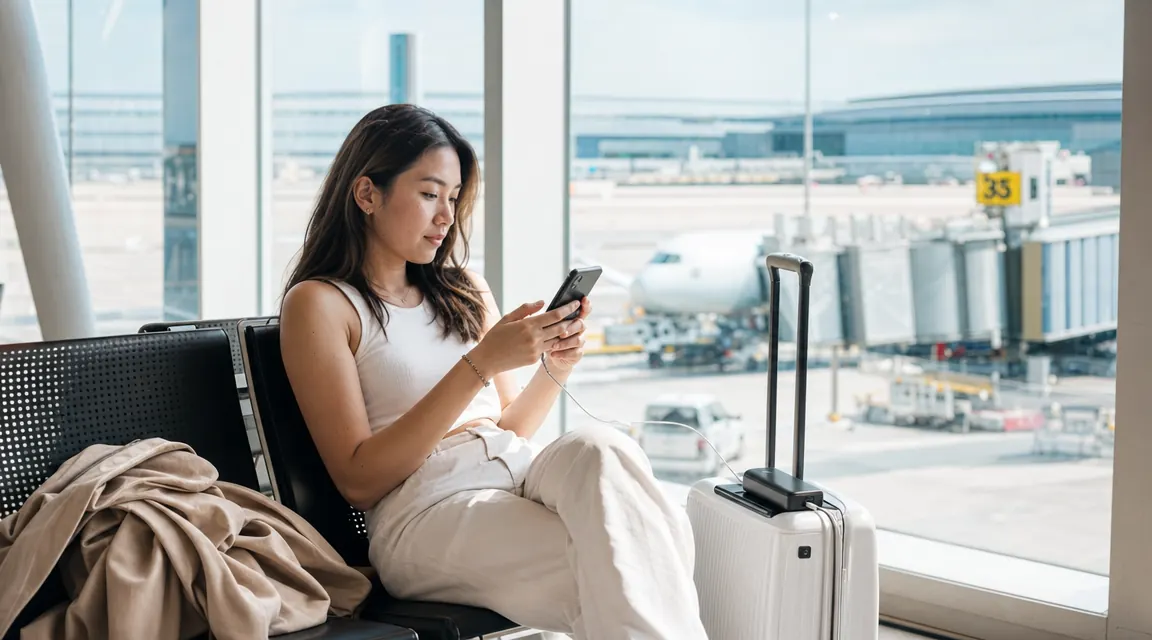
My phone hit 9% on a connection in Denver last March, with 45 minutes until boarding and a boarding pass that only existed on that screen. I had a laptop charger in my bag and not a single outlet within sprinting distance. I made the gate. Barely. That was the last time I traveled without a system for keeping every device charged from takeoff through the hotel room door.
The problem most people have is not that they forget to pack a power bank. It is that they pack one and still run out of power. They charge the wrong device first, drain the bank before the long leg of the trip, or bring a cable that does not actually match the ports they need. On a 12-hour travel day with a phone, wireless earbuds, a smartwatch, and a tablet, a bad charging sequence will leave you dark by hour seven. This guide walks through the exact five-step system I now follow every time I leave home, built around the INIU 45W 10000mAh Portable Charger that has been in my bag for the past eight months.
Stop gambling on airport outlets. This is the power bank I trust for long travel days.
The INIU 45W Portable Charger holds 10000mAh, passes TSA carry-on rules, and has a detachable cable so you are never hunting through your bag for the right one. Over 80,000 Amazon ratings and counting.
Amazon Check Today's Price on Amazon →Step 1: Audit Your Devices and Their Real Capacity Needs Before You Pack
This step takes about three minutes and most people skip it entirely. Before any trip, I list every device I am traveling with and its approximate battery capacity in mAh. A modern iPhone 15 has roughly a 3,300mAh battery. Most wireless earbuds cases hold between 450mAh and 700mAh. A smartwatch like a Garmin Fenix or an Apple Watch runs 300 to 500mAh. A small tablet like an iPad Mini has a 5,100mAh battery. Add those up and you know how much total power you are managing.
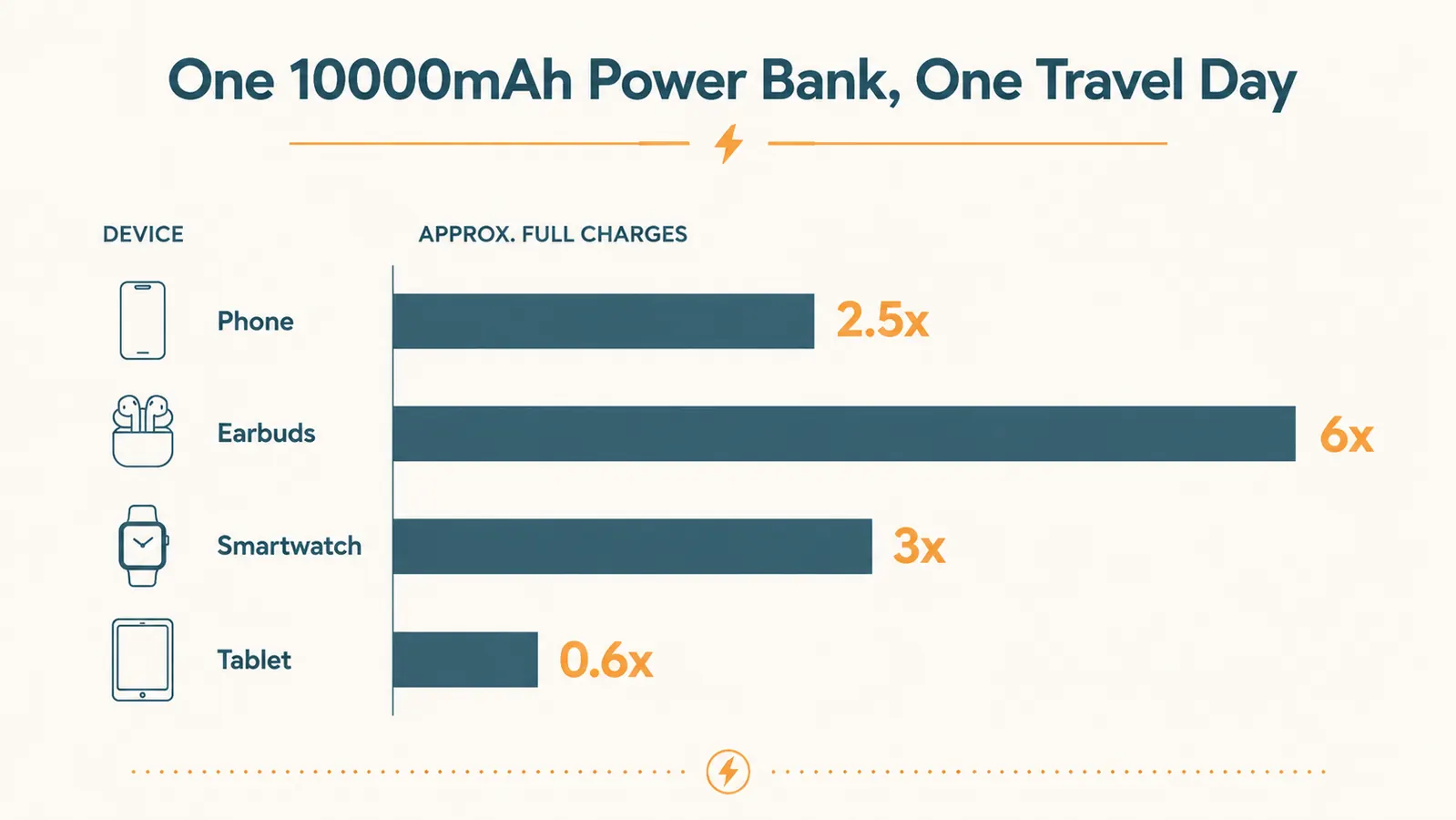
The INIU bank holds 10,000mAh on paper, which translates to roughly 6,500 to 7,000mAh of usable output after conversion loss. That is enough to charge a modern phone about twice, run your earbuds through six full cycles, and top up a smartwatch three times. It will not fully charge a standard iPad, but it will get one from 30% to full. Knowing this before you leave means you are making a real plan, not hoping for the best.
Write the list on your phone notes app or just mentally map it. The point is to go into the travel day knowing what you have and how far it goes, not discovering the limit when you are in row 34 with four hours left in the flight.
Step 2: Charge the Power Bank to 100% the Night Before, Every Time
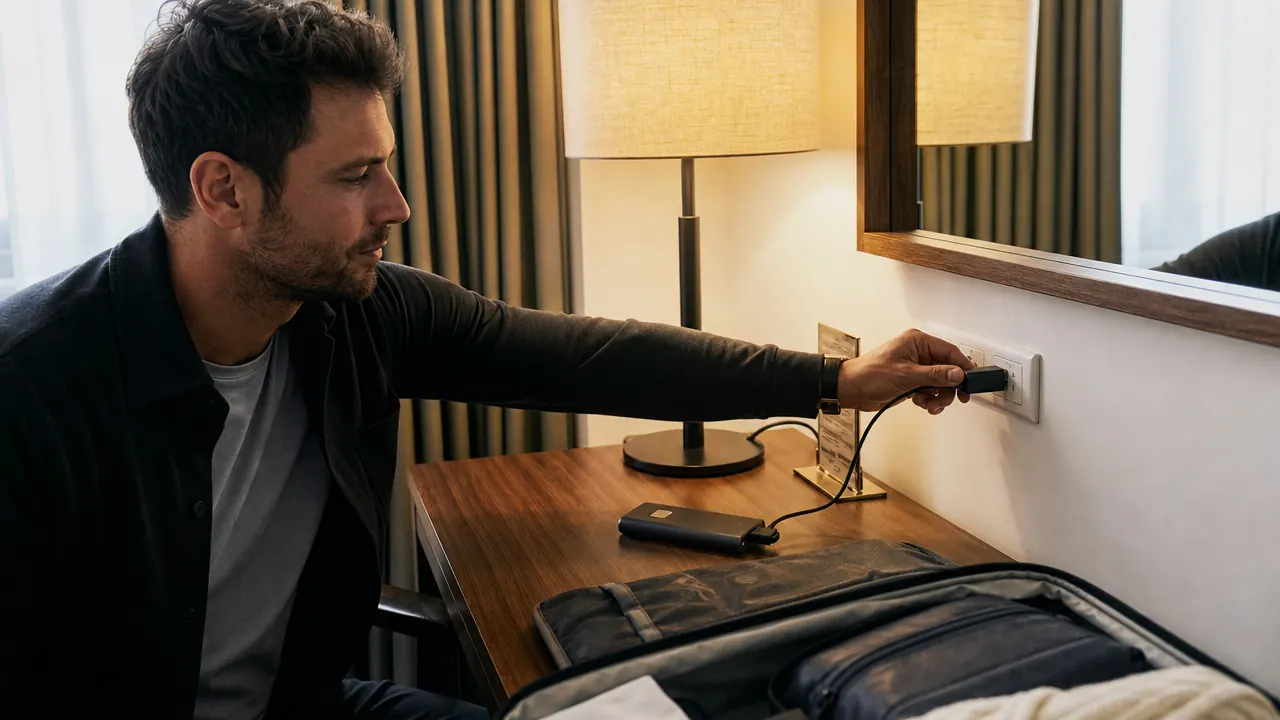
This sounds obvious but it is the single most common mistake I see when traveling with other people. They assume the bank has enough juice from the last trip. A 10,000mAh bank at 60% capacity is a very different tool than one at 100%. On a long travel day, that difference is real. I plug the INIU in the night before departure, every trip, without exception. The bank takes about two hours to go from zero to full with a standard USB-C charger, and it charges faster with a 45W PD adapter.
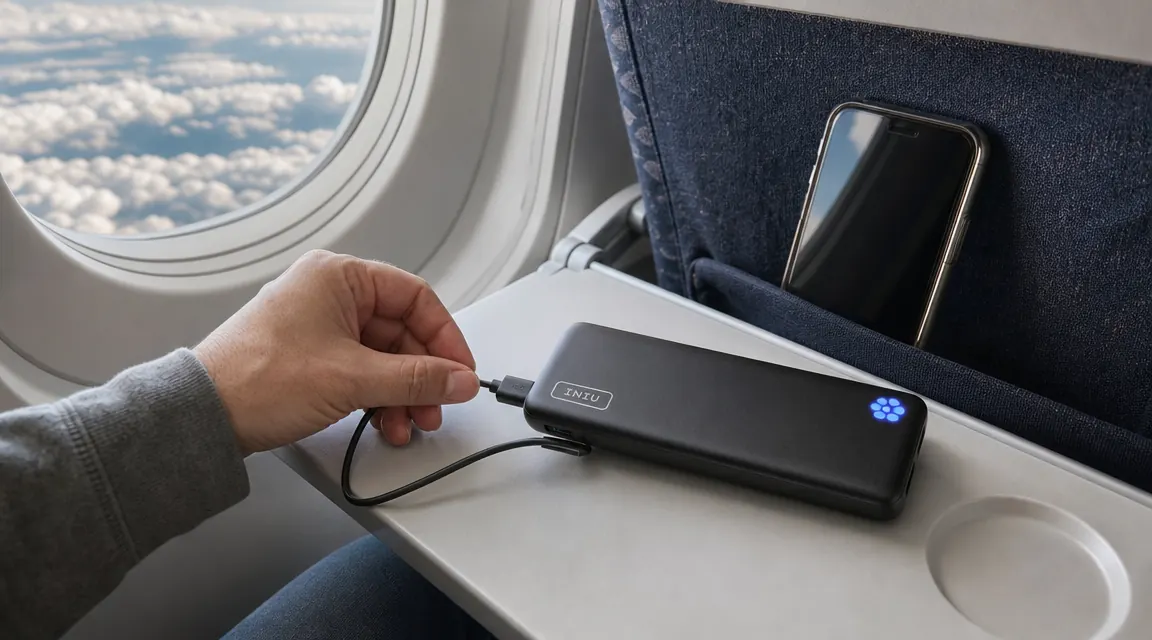
One thing I appreciate about the INIU specifically: the LED indicator is clear enough that you can tell at a glance whether it is full without doing math. Four lights means full. Two lights at the bottom means you are below half. I have been burned by power banks with ambiguous indicators that showed three out of four bars and then died an hour into the flight. The INIU has not done that to me yet.
While the bank is charging overnight, also charge every device you are traveling with. Start every travel day at 100% across the board. It sounds like a lot of cables plugged in at once, but it means you enter the travel day with no debt. You are spending the power bank's reserves, not chasing a deficit you started with.
Step 3: Pack the Right Cables, Not All the Cables
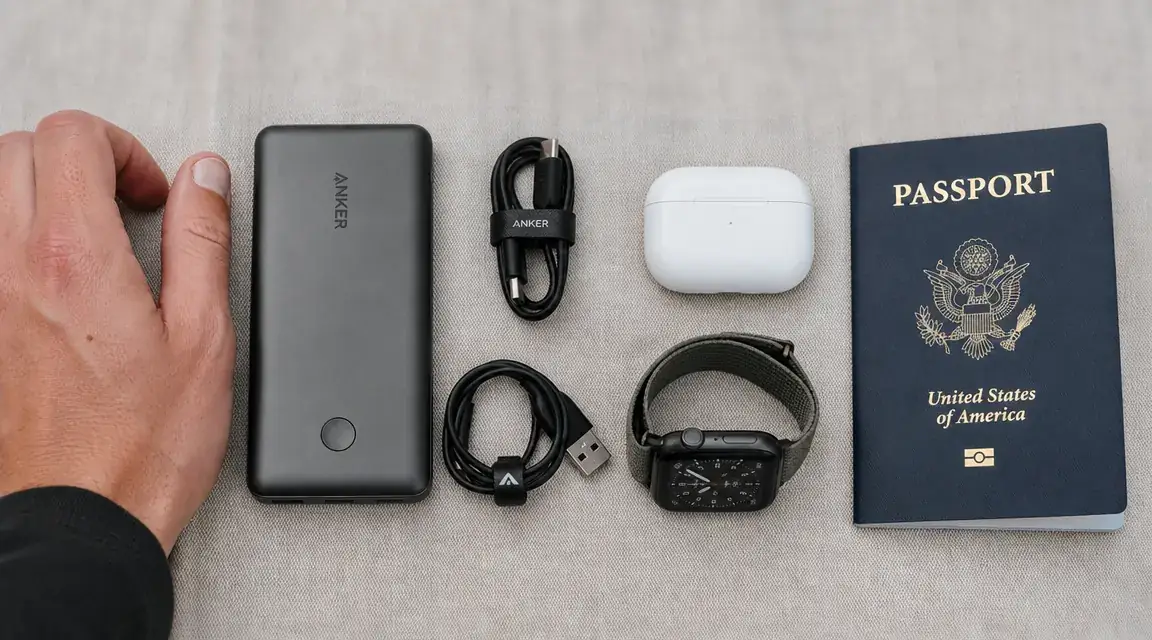
I used to travel with a tangle of five or six cables and still somehow never have the right one. Now I carry two: one short USB-C to USB-C cable for phone and earbuds, and one short USB-C to Lightning cable if I am traveling with any Apple devices that have not switched yet. Short cables matter here. A six-foot cable in a carry-on bag is a liability. A one-foot cable stays contained, sits cleanly on a tray table, and does not create a snag hazard in the seat pocket.
The INIU 45W bank ships with a built-in retractable cable, which is one of the reasons I picked it over other options. It handles phone charging right out of the pocket without me needing to find a cable first. For devices with different port requirements, I carry one backup USB-C to USB-C cable in the small front pocket of my personal item. That is it. Two total. It simplifies every charging interaction during the day.
One thing to consider: the INIU supports 45W output on its USB-C port, which means it can charge a MacBook Air or a recent iPad Pro at a useful speed. If you are carrying a laptop and a tablet, this one bank can serve both. You just need the right cable for each. Pack the cables you actually need, not an insurance policy for every port that has ever existed.
Step 4: Charge in the Right Order Throughout the Travel Day
This is where the actual strategy lives. Not all devices are equal in urgency, and charging in the wrong order will leave your most critical device low when you need it most. My priority order is: phone first, earbuds second, smartwatch third, tablet last. The phone is your boarding pass, your navigation, your emergency contact. It never drops below 30% if I can help it. The earbuds matter on long flights but are not life-critical. The tablet can run lower.
On a layover, I plug the phone into the INIU the moment I sit down, even if it is at 70%. Top it off while I am waiting. Do not wait until it is at 20% to start charging, because that means you are in reactive mode and the gate could call boarding at any moment. The INIU's 22.5W fast charge via its USB-A port means a phone goes from 30% to 80% in about 40 minutes, which is usually enough for the next leg.
Earbuds are the easiest to manage because the case itself is a battery. I plug the case into the bank during a meal or a layover sit, let it charge for 20 minutes, and that is usually enough to refill it completely. Smartwatches are similar. I throw the watch on its charger during a long sit, not during active transit. The goal is to use every idle moment to top something off, so nothing bottoms out during the parts of the day when you are moving.
Step 5: Top Off the Power Bank Whenever a Plug Is Available
This is the habit that separates people who run out from people who do not. Any time there is an accessible outlet, and you have a few minutes of sitting time, plug in the power bank. Gate seating with outlets, airport lounge charging stations, hotel rooms during check-in, the desk in the Airbnb. You are not waiting until the bank is at zero to charge it. You are keeping it topped up the same way you keep your phone topped up.
The INIU charges via USB-C at up to 20W input, so it is refilling at a decent rate even with a basic travel adapter. On a 90-minute layover with access to an outlet, you can recover 30 to 40% of the bank's capacity just by keeping it plugged in while you eat or read. That means you arrive at your final destination with a bank that is still useful for the hotel room and the next morning.
One note on TSA: the INIU 45W 10000mAh bank is carry-on compliant. Power banks under 100Wh are allowed in carry-on bags, and this one comes in at 37Wh. It cannot go in checked luggage, but that has never been a problem for me because it lives in my personal item anyway. I have taken it through security in the US, Europe, and Southeast Asia without issue.
What Else Helps
The power bank does the heavy lifting, but a few other habits make the system run cleaner. First, enable Low Power Mode on your phone at 50% on long-haul days, not at 20%. It slows battery drain without making the phone unusable. Second, turn airplane mode on during flights where you genuinely do not need connectivity. Airplane mode cuts power consumption dramatically because the radio chips are the biggest battery drain on any smartphone. Third, if you are traveling with a companion, talk through who has what charge before you leave. Two people with two phones and one power bank need a plan, not a competition.
I also keep a USB wall adapter in my bag at all times, not just the power bank. The bank is the portable solution, but whenever I am at a hotel or an airport lounge with open outlets, I would rather charge directly from the wall and preserve the bank for the next stretch of transit. The INIU pairs well with any USB-C PD wall charger, and the combination of the two means I almost never think about battery anxiety anymore. That is a very good state to be in when you are traveling carry-on only.
The travelers who never run out are not the ones with the biggest power bank. They are the ones with a system. Charge in priority order, top off during idle moments, and start every leg of the trip with more than you think you need.
For a deeper look at the INIU bank's long-term durability and how it holds up after months of real use, see my full INIU 45W Power Bank Review. And if you are on the fence about whether a slim bank is worth the trade-off over a heavier one with more capacity, the 10 reasons a slim power bank beats a bulky charger breakdown covers that comparison in detail.
Ready to stop gambling on airport outlets? The INIU 45W bank fits in a jacket pocket and lasts all day.
Compact enough for carry-on, powerful enough for 45W fast charging, and TSA-compliant for every flight. With over 80,000 Amazon ratings at 4.5 stars, it is the most-proven slim travel power bank on the market.
Amazon Check Today's Price on Amazon →