
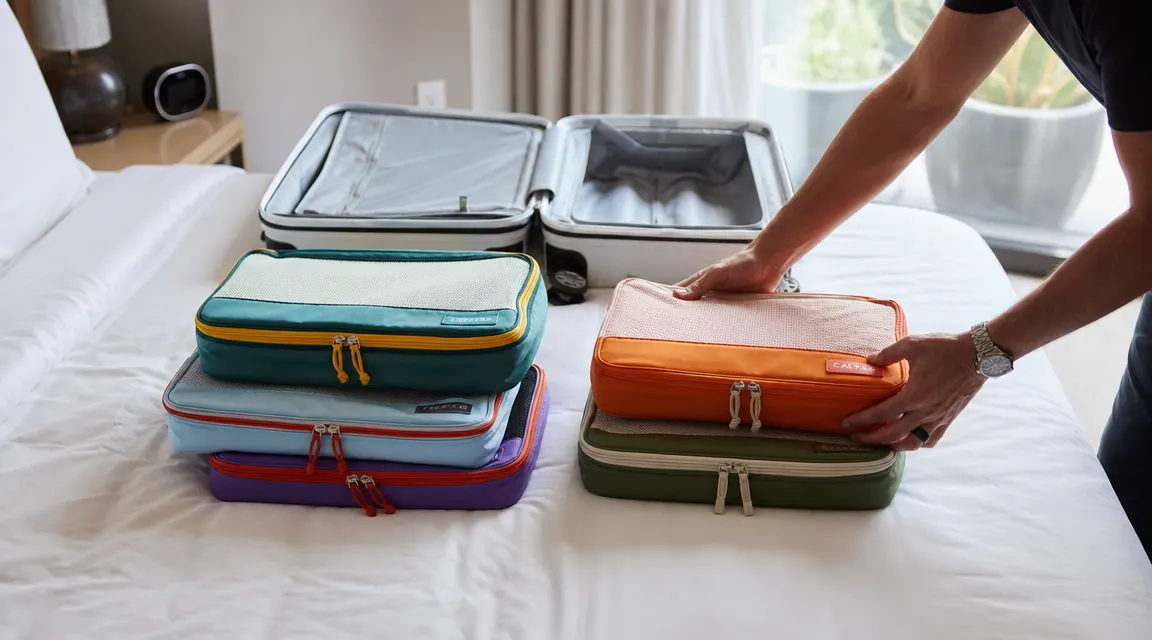
I have been a carry-on-only traveler for six years and in that time I have gone through probably a dozen different packing cube sets. The question I get most from newer travelers is some version of this: should I just buy the cheap ones on Amazon or spend real money on Eagle Creek? It is a fair question with a more nuanced answer than most gear blogs give you. Eagle Creek has been the benchmark for packing cubes since long before Amazon had a travel accessories category. Their Pack-It line has a lifetime warranty, silnylon construction, and a reputation built across decades of adventure travel. BAGAIL, on the other hand, costs less than two airport cocktails for a full eight-cube set and has accumulated over 42,000 reviews at 4.6 stars, which is either impressive or suspicious depending on how much you trust Amazon review counts.
I used both systems across 15 trips over the past year. Those trips ranged from one-night business hops between cities to a ten-day trip through Portugal and Spain, a week in Mexico City, and a long weekend in Denver where the airline actually lost my checked bag for six hours and I was grateful I had my carry-on dialed in. I packed, unpacked, repacked, and stress-tested compression claims on both sets under real conditions, in real airports, with real time pressure. Here is what I actually found.
| BAGAIL 8-Set Packing Cubes | Eagle Creek Pack-It Specter | |
|---|---|---|
| Price | 8 cubes included | Moderate cost for a 4-cube set |
| Set Size | 8 cubes across 3 sizes | 4 cubes across 2 sizes |
| Material | 210D ripstop nylon | 15D silnylon (ultralight) |
| Zipper Quality | Smooth dual-pull, holds under tension | Lockstitch YKK, very precise and reliable |
| Compression | Double-zip compression panel on all cubes | Single zip; slimness replaces compression |
| Total Weight (full set) | ~9.8 oz (8 cubes) | ~3.2 oz (4 cubes) |
| Warranty | No stated warranty | No-questions-asked lifetime warranty |
| Best For | Families, first-timers, 5+ day trips | Ultralight backpackers, minimalist travelers |
| Amazon Rating | 4.6 stars (42,000+ reviews) | 4.4 stars (1,500+ reviews) |
Stop overpacking and under-organizing: the eight-cube BAGAIL set that changed how I pack
Three sizes, double-zip compression, and enough cubes to cover every category. Check current pricing on Amazon before the next trip sneaks up on you.
Amazon Check Today's Price on Amazon →Where BAGAIL Wins the Comparison
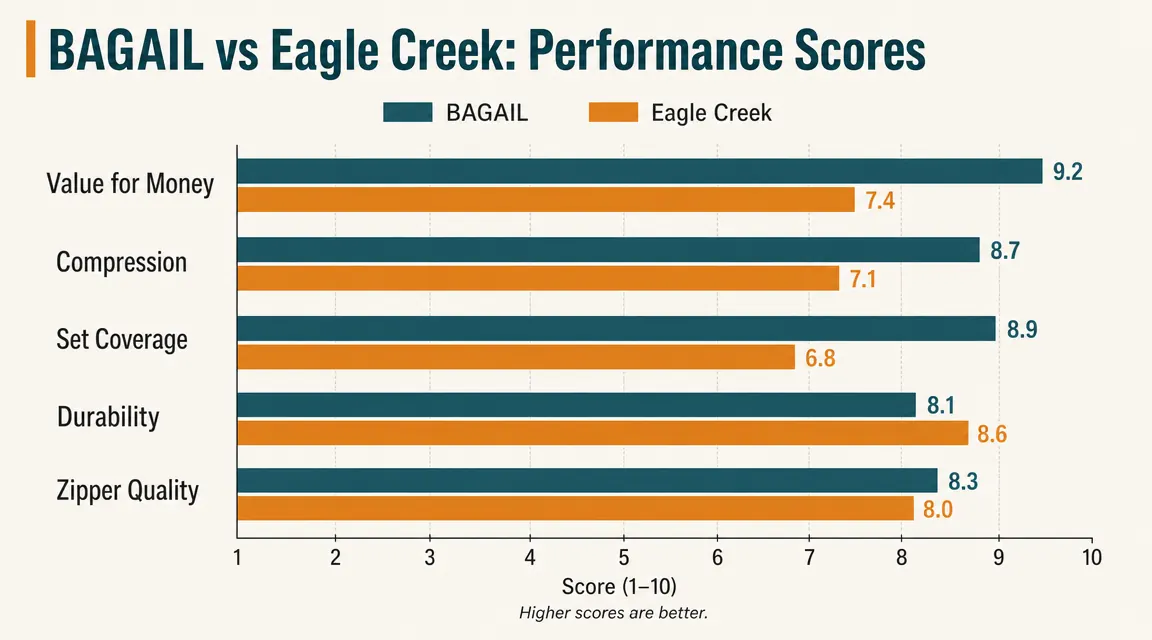
The most immediate advantage BAGAIL has is sheer coverage. Eight cubes in three sizes means I can slot every packing category into its own container: two XL cubes for shirts and pants, two medium cubes for layers, workout clothes, and bulkier items, and four small cubes for socks, underwear, charging cables, and anything I need to pull out quickly at the hotel without excavating the whole bag. Eagle Creek's four-cube Specter set forces me to combine categories, which usually means a stuff sack or a gallon Ziploc filling the gap. On a family trip where you are packing for two or three people, the difference is even more pronounced. BAGAIL gives you a cube per person per category. Eagle Creek gives you a tight system that works only if your packing is already very dialed in.
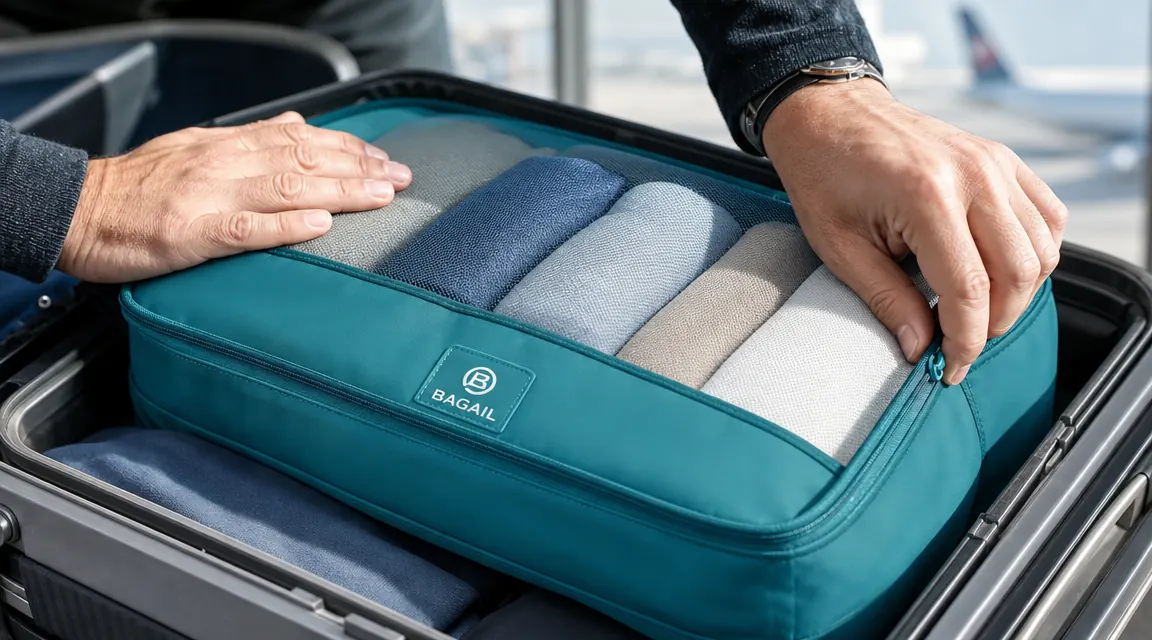
The double-zip compression panel genuinely surprised me. On most budget cubes I have used, compression is a word printed on a hangtag that corresponds to nothing real inside the bag. BAGAIL's compression side actually works. By zipping the perimeter compression zipper after the main compartment is closed, I can collapse the cube depth by roughly a quarter to a third, depending on how tightly I rolled the clothes inside. On my Portugal trip I packed for eight days in a 22-inch roller without checking anything. That included four shirts, two pairs of pants, a light jacket, shorts, two pairs of shoes, and a full toiletry kit in my personal item. The compression panel on the BAGAIL XL cubes is a real part of why that worked.
Then there is the price, which is not a small consideration. At a budget price point for the complete set, BAGAIL costs roughly one-third of a comparable Eagle Creek setup. If a zipper fails after two years of heavy use, you replace the whole set for less than Eagle Creek charges for a single cube. That changes how you treat the gear. I do not baby the BAGAIL cubes the way I would a premium investment. I stuff them, sit on them to close my bag, toss them into overhead bins without a packing sleeve, and generally treat them like the working tools they are. They respond well to that treatment.
Where Eagle Creek Wins the Comparison
Eagle Creek's dominant advantage is weight, and the gap is bigger than you might expect. The silnylon fabric in the Pack-It Specter line is genuinely featherweight material. The full four-cube Specter set weighs around 3.2 ounces total. The eight-cube BAGAIL set weighs closer to 9.8 ounces. That 6-ounce difference is meaningful on airlines where hand luggage limits are enforced by scale, not by eye. If you are flying Ryanair or Spirit with a strict 10-pound personal item cap, six ounces is one pair of shoes or the margin between clearing the scale and paying a gate fee. For ultralight travelers who count grams, Eagle Creek is not even close.
The lifetime warranty is the other place Eagle Creek's case is airtight. This is not a warranty you have to fight to use. Eagle Creek replaces defective products, no receipt required, no return shipping argument. A friend of mine sent back a Pack-It cube with a zipper that had started skipping after four years of international travel. Eagle Creek shipped a replacement to her door in about a week. No proof of purchase, no photos of the defect, no negotiation. If you are the kind of traveler who buys gear once and uses it for a decade, the Eagle Creek premium actually becomes cheaper over time than replacing a budget set every two or three years.
The zipper construction and overall material quality are also noticeably superior up close. Eagle Creek's zipper pulls track with a precision that is hard to describe until you have run both sets side by side in the same bag. BAGAIL's zippers are smooth and have never snagged or failed in my testing, but they have a slightly looser feel under tension, especially when the cube is packed tight and you are working the zipper around a corner. After a year of use, the Eagle Creek zippers feel identical to day one. The BAGAIL zippers still work perfectly, but there is a small amount of additional drag that was not there when the cubes were new.
Eagle Creek earns every dollar of its premium for the traveler who needs to cut weight and plans to use the same set for a decade. For everyone else, BAGAIL delivers more cubes, real compression, and money back in your pocket for the actual trip.
Real-World Durability: What Happened Over 15 Trips
I put both sets through genuinely rough handling over the past year. Both survived without catastrophic failure, but the wear patterns were different in telling ways. The BAGAIL cubes showed mild corner pilling on the two XL cubes starting around trip eight or nine. The fabric at the points where the cubes meet the corners of the suitcase developed a light fuzz. Nothing structural, no holes, no separation at the seams, but visible texture change if you look closely. The mesh panels on all eight cubes stayed intact. Every zipper still runs clean. The compression panels show no signs of delaminating or losing their tension. For an affordable set, the durability is genuinely better than I expected going in.
The Eagle Creek cubes showed essentially no wear after the same period. The silnylon fabric on the Pack-It Specter set looks functionally identical to the day I unboxed it. The zippers track at the same tension. The seams show no fraying. This is the part of the Eagle Creek story that the price tag earns: these cubes will almost certainly outlast whatever suitcase you put them in. If I were making a 20-year-gear-buy decision, Eagle Creek would be the answer without much deliberation. But the BAGAIL set is performing well enough that I have no reason to replace it yet, which is honestly all I can ask from travel gear.
How Each Set Fits Into a Real Packing System
One thing neither brand tells you clearly is how differently the two sets integrate into an actual packing workflow. With BAGAIL, I built a category-based system: shirts in XL cube one, pants and shorts in XL cube two, socks and underwear in a small cube, cables and adapters in another small cube, gym clothes in a medium cube. Everything has a home and I never dig through the bag looking for something. When I arrive at a hotel, I pull out the cubes I need and leave the rest in the suitcase. It takes about 90 seconds to fully unpack, which is a thing you appreciate more than you would expect after a long travel day.
With Eagle Creek, you are working with four cubes and two sizes. That forces a more edited approach. You combine categories that you would keep separate with BAGAIL, which is fine if you have a minimalist packing philosophy but awkward if you are a person who packs one outfit per day and needs a cube for each type of clothing. The Eagle Creek system rewards the traveler who already knows exactly what they need and has cut their packing list down to the bone. The BAGAIL system rewards anyone who is still figuring out how to make carry-on-only work without leaving half their clothes at home.

Who Should Buy BAGAIL
Buy BAGAIL if you are trying packing cubes for the first time and do not want to spend a lot to find out whether you even like the system. Buy BAGAIL if you are packing for multiple people on a family trip and need enough cubes to keep everyone's gear separated. Buy BAGAIL if you prioritize fitting more clothes in less space over trimming half a pound off your bag weight. Buy BAGAIL if you fly six to fifteen times a year on normal carriers where bag limits are not enforced to the exact ounce. Buy BAGAIL if you want a set that will realistically last three to five years of regular travel before you need to think about replacing it. The 42,000-plus Amazon reviews at 4.6 stars are not a coincidence. This is a genuinely good product at a price point that is hard to argue with.
Who Should Buy Eagle Creek
Buy Eagle Creek if you are a frequent international traveler on budget airlines where bag weight is measured, not estimated, and every ounce actually costs you money. Buy Eagle Creek if you already have a tight packing system built around four or fewer categories and do not need eight cubes to organize it. Buy Eagle Creek if you want to make one packing cube purchase in your life and never think about replacing them. Buy Eagle Creek if you travel enough that a lifetime warranty on your gear is a reasonable long-term investment rather than a marketing footnote. And buy Eagle Creek if worn corners and fabric texture change bother you more than a higher upfront price.
There is one specific scenario where I would recommend Eagle Creek to almost anyone regardless of budget: ultralight carry-on travel on strict-weight-limit carriers like Ryanair, Wizz Air, or Spirit, where personal item limits are enforced at 10 to 15 pounds and checked bag fees are steep. In that scenario, the 6-ounce gap between the two full sets can be the difference between clearing the scale and paying a gate surcharge. Outside of that scenario, BAGAIL is the more practical choice for the majority of travelers reading this.
The eight-cube packing system most carry-on travelers actually need, at a price that leaves room for the trip itself
BAGAIL gives you three sizes, real compression, and enough cubes to build a complete packing system on a first-trip budget. Check today's price on Amazon and see why 42,000 travelers gave it 4.6 stars.
Amazon Check Today's Price on Amazon →